Healthcare CRM for Clinics and Hospitals in the United States

Your EHR manages the medical record. But it does not manage the full patient relationship. Tenebit Healthcare CRM connects patient access, patient 360, AI omnichannel service, complaints, referral management, treatment adherence, and HL7 FHIR interoperability in one operating layer for clinics, hospitals, and medical groups.

Request a CRM demo
Useful definition

What is a healthcare CRM and why is it different from a generic CRM?

A healthcare CRM is a patient relationship platform built to organize access, service, follow-up, experience, and continuity around the patient journey. Unlike a generic CRM, a healthcare CRM must support patient access, scheduling, complaints, referral management, care-gap outreach, adherence, and omnichannel communication in coordination with the EHR and operational systems. It should also work as a CRM integrated with EHR, contact center, and scheduling workflows. HL7 defines FHIR as a standard for exchanging healthcare information electronically, so a CRM with HL7 FHIR interoperability becomes operational infrastructure rather than an optional add-on for clinics, hospitals, and medical groups.

Sources: HL7 FHIR Overview · AHRQ: About CAHPS

Practical comparison

Healthcare CRM vs Generic CRM vs EHR: what does a provider actually need?

A healthcare organization does not need to replace its EHR to improve patient access, service, and continuity. It needs a healthcare CRM that complements the EHR, connects the patient journey, and helps teams operate patient 360, no-show reduction, complaint handling, referral workflows, and omnichannel service with traceability.

Criteria Healthcare CRM Generic CRM EHR
Primary objective Manage patient relationships, access, experience, continuity, and measurable service workflows. Manage opportunities, accounts, sales activity, and commercial pipelines. Manage the medical record, clinical documentation, orders, and care delivery information.
Best fit Patient 360, omnichannel healthcare, complaints, adherence, referrals, care-gap outreach, and journey visibility. Lead tracking, sales forecasting, campaigns, and account-based follow-up. Clinical notes, orders, results, coding, and core clinical workflows.
Main users Patient access, contact center, service, quality, experience, growth, and operational teams. Sales, marketing, and business development teams. Physicians, nurses, front desk, billing, and clinical operations.
Key integrations CRM integrated with EHR, scheduling, ERP, contact center, messaging channels, surveys, and HL7 FHIR. Email, commercial automation, telephony, and marketing tools. Labs, imaging, pharmacy, billing, and other clinical systems.
Value signals Lower no-show, stronger access conversion, better experience, more traceability, and more coordinated service. Higher sales productivity and better pipeline control. Better clinical documentation, safer records, and stronger support for care delivery.
United States context

What healthcare CRM software should solve in the United States

A healthcare CRM in the United States should improve patient access, reduce friction, support patient engagement, and help care teams act with context across commercial, operational, and service moments. The goal is not only more demand, but better continuity and more measurable patient relationships.

Patient access and conversion

It should help convert calls, forms, and digital inquiries into completed appointments with less friction and more visibility into where patients drop off.

EHR and workflow integration

It should work as a CRM integrated with EHR, scheduling, and operational systems so teams do not duplicate work between service and clinical tools.

Role-based access and auditability

It should support healthcare-grade permissions, audit trails, and controlled access to sensitive operational and patient-facing information.

Complaints and service recovery

It should help teams manage complaints, grievances, and patient experience signals before they become churn, escalation, or reputational damage.

Referrals, follow-up, and leakage

It should make referral management, post-visit follow-up, and care continuity visible so organizations can reduce silent patient leakage.

HL7 FHIR and patient 360

It should behave like a patient 360 platform with HL7 FHIR interoperability so access, service, and engagement teams work with the same patient context.

The Problem

50% of CRM Implementations Fail. Not Because of the Software.

According to Gartner and Forrester, 50% of CRM implementations fail. The most common mistake: prioritizing technology over strategy. At Tenebit, we’ve been solving this problem for 16 years: we are a company with a strategic focus before a technological one. The CRM is the tool. We are the team.

Wrong priorities

Implementing technology without a clear patient relationship strategy is the root cause of most failures.

No ongoing support

Most vendors deliver the license and leave. Without continuous support, adoption drops.

Generic CRM

Commercial CRMs don’t understand the difference between a PPO patient and a self-pay one, nor do they speak HL7/FHIR.

Low adoption

Without training and cultural change, the medical and administrative team ends up not using the tool.

Patient 360

Patient 360 — The View You Were Missing

One single screen. The patient’s entire history: appointments, messages, prescriptions, referrals, care programs, survey results, grievances. No information silos. No duplicates. No spreadsheets.

Our patient-centered data model includes a unified longitudinal history, risk profiles, simultaneous care plans and visibility into all programs the patient is enrolled in.

Unified longitudinal history

All patient interactions on a single timeline: appointments, messages, calls, referrals and programs.

Risk profiles

Automatic identification of patients at risk of abandonment, adherence gaps or clinical complications.

Simultaneous care plans

Management of multiple active programs per patient with cross-visibility for the entire care team.

Automatic deduplication

Elimination of duplicate records with matching algorithms. Complete audit trail on every action.

Platform in action

Explore 5 real CRM capabilities

See how Tenebit Healthcare CRM brings together conversations, reporting, grievances, commercial visibility, and patient context in one operational layer for clinics and hospitals.

Section 01

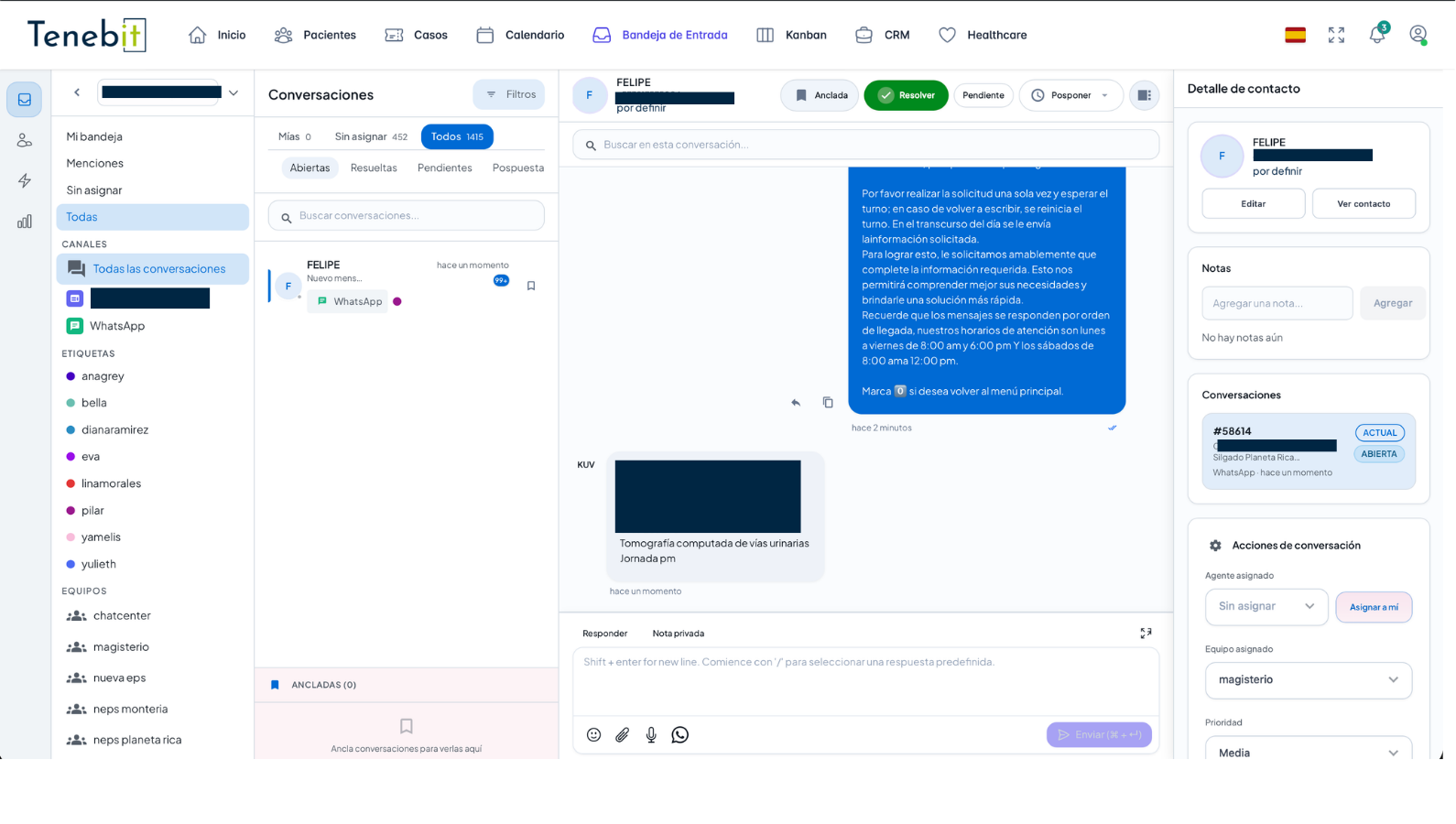
Unified omnichannel inbox

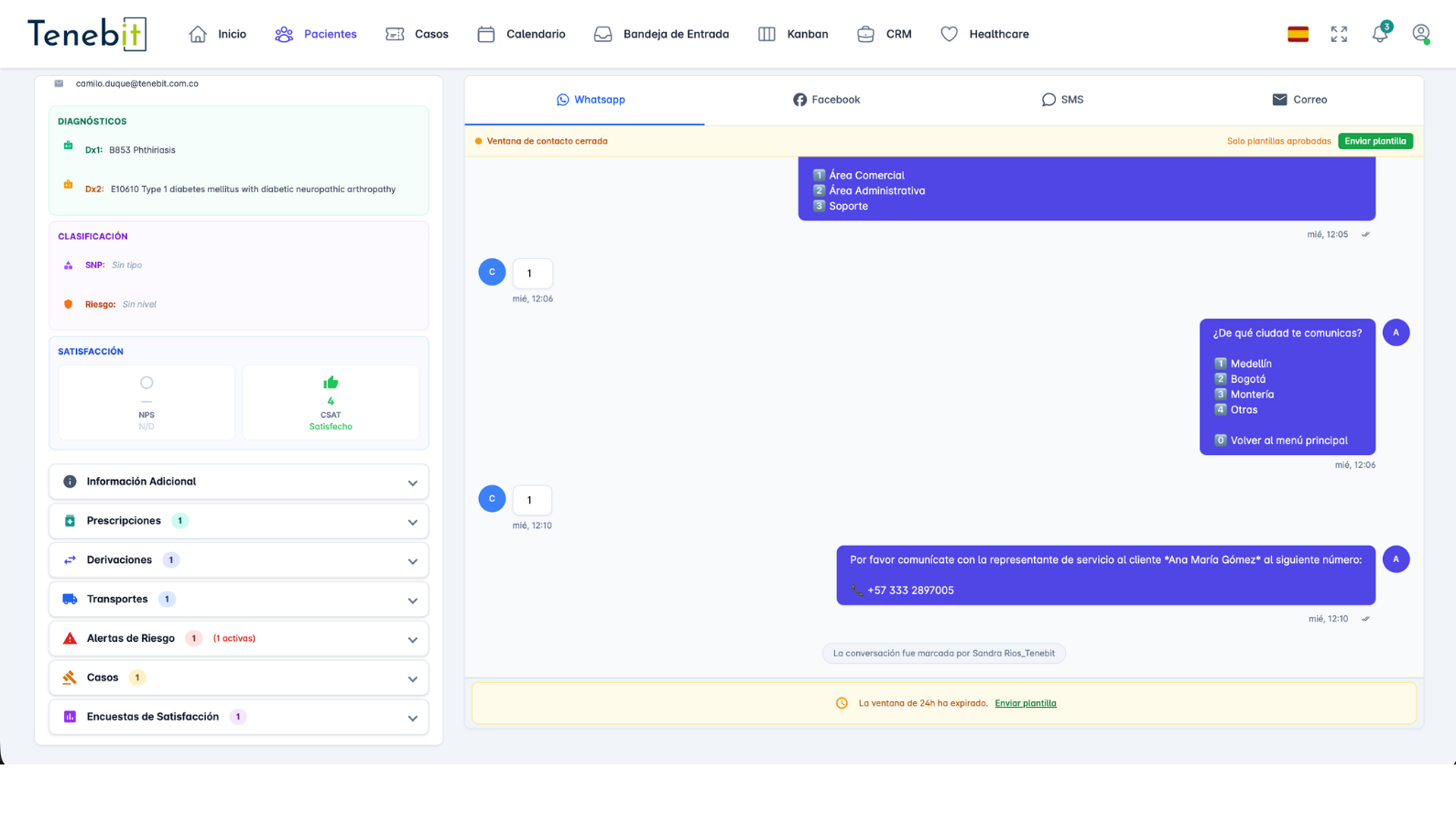
Bring patient conversations into one inbox so your teams can respond with context, traceability, and continuity across channels.

  • Reduces response time by centralizing WhatsApp, chat, and case-related conversations.
  • Lets the clinic see history, priority, and ownership before replying.
  • Improves continuity by preventing conversations from getting lost between teams.
Unified omnichannel inbox with patient conversation context in Tenebit Healthcare CRM
Section 02

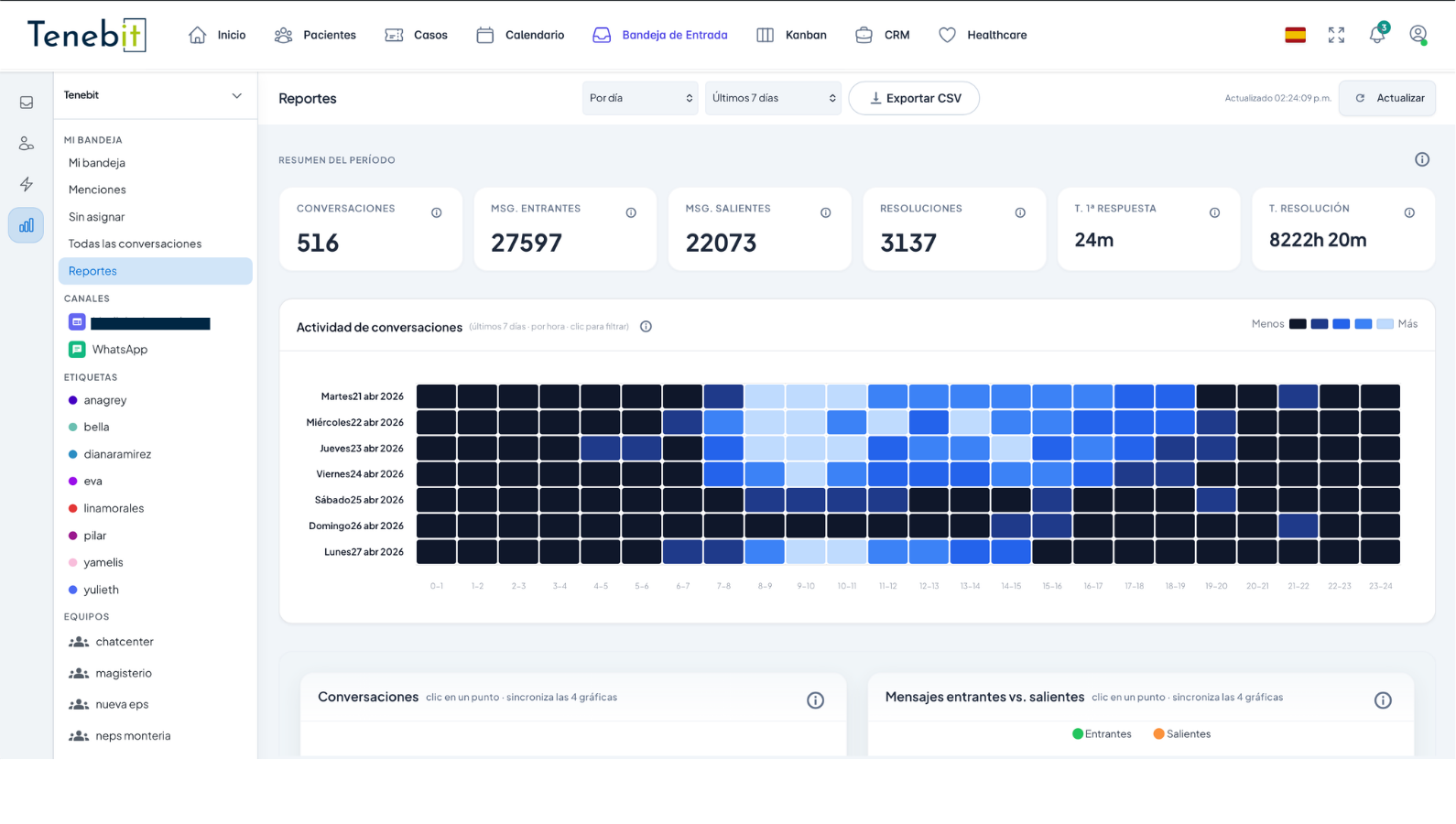
Omnichannel service reporting

Turn every interaction into operational analytics so leaders can monitor load, productivity, response time, and service performance.

  • Helps identify peak hours, bottlenecks, and overloaded teams.
  • Supports decisions with data on first response, resolution, and volume.
  • Gives daily visibility into contact-center and patient-service performance.
Omnichannel service and productivity reporting in Tenebit Healthcare CRM
Section 03

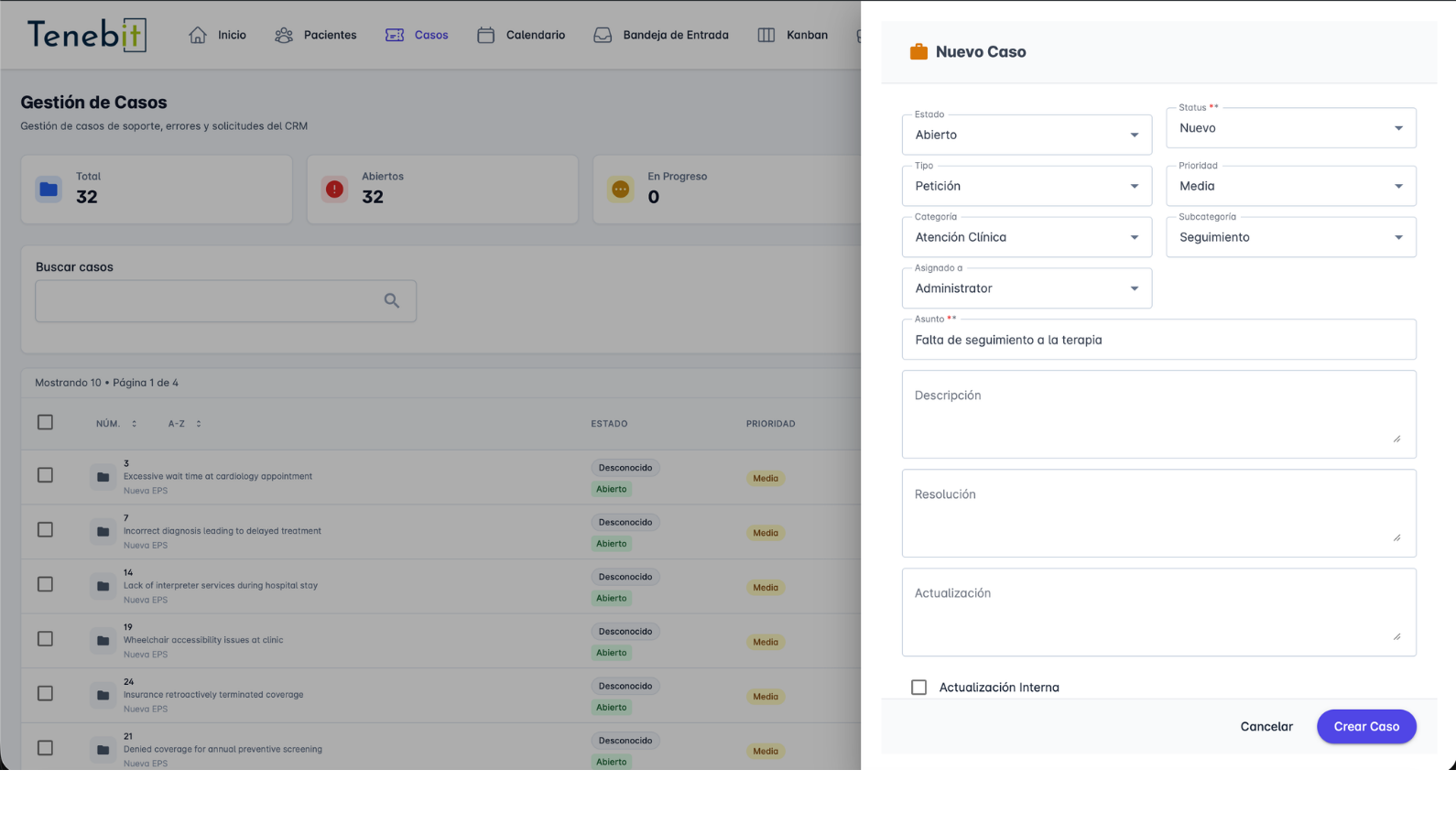
Structured grievance and case management

Organize complaints, requests, and service cases in traceable workflows with ownership, priority, and documented resolution.

  • Structures intake with classification and assignment rules.
  • Reduces rework by documenting cause, progress, and resolution in one place.
  • Helps the organization learn from friction points and repeated patterns.
Complaint, request, and case management module in Tenebit Healthcare CRM
Section 04

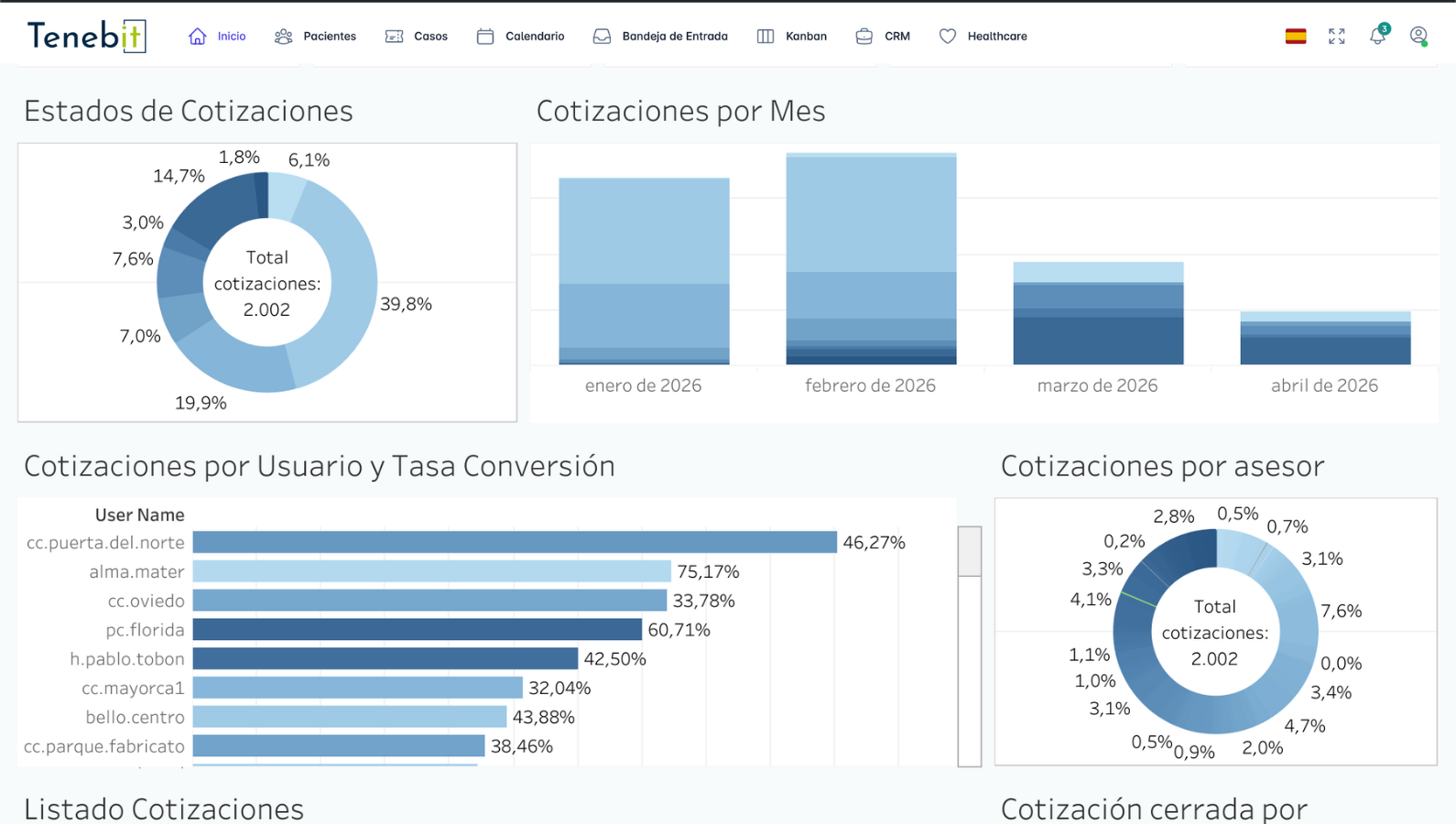
BI reporting for growth and operations

Consolidate conversion, demand, productivity, and follow-up indicators so leadership can align growth decisions with operational reality.

  • Compares sites, teams, and conversion rates in a single dashboard.
  • Makes improvement opportunities visible across acquisition and follow-up.
  • Connects management decisions with real operational and commercial evidence.
Business intelligence dashboards and reporting inside Tenebit Healthcare CRM
Section 05

Unified patient view

Bring together diagnoses, classification, satisfaction, referrals, programs, and conversations in one view so every team acts from full context.

  • Gives clinics a more complete reading of each patient and journey stage.
  • Supports more tailored follow-up, education, and adherence workflows.
  • Reduces silos between service, patient experience, contact center, and programs.
Unified patient 360 view with clinical and operational context in Tenebit Healthcare CRM

Would you like to see a CRM project designed around your clinic’s requirements?

Let’s talk about processes, channels, integrations, use cases, and measurable goals so the CRM design reflects the reality of your organization.

10 Modules

10 Modules Integrated. One Team Behind Them.

Each module solves a specific patient management challenge. All connected to each other, feeding a single patient view, operated by one team that supports you.

Module 01

Intelligent Scheduling

Multichannel self-scheduling (web, WhatsApp, voice, app), automatic confirmations, no-show management, intent classification with NLP before assigning the appointment. Bidirectional sync with your HIS or ERP.

Module 02

AI Omnichannel

WhatsApp, voice, web chat, email and SMS in a single inbox. AI for intent classification, initial triage, automated response and escalation to a human when clinical urgency signals are detected.

Module 03

Patient 360

Longitudinal patient timeline: appointments, messages, referrals, prescriptions, transportation, programs. Automatic deduplication. Complete audit trail.

Module 04

Referral Management

Referrals and counter-referrals with complete traceability. Configurable SLAs, automatic escalation to supervisor when deadlines expire, cycle closure with the referring provider. Network leakage detection.

Module 05

Prescription Adherence

Dispensation tracking, adherence gap alerts by drug class, automated refill campaigns. PDC (Proportion of Days Covered) by therapeutic class.

Module 06

Grievances & Experience

Grievance tracking and management with configurable workflows, NPS, CSAT and automatic PREMS/PROMS post-event. Sentiment analysis on calls. Predictive churn risk score.

Module 07

Care Programs & Pathways

Design and configuration of chronic care models. Control tower with early alerts. Regulatory compliance aligned with CMS and HEDIS standards.

Module 08

Gaps & Preventive Programs

Import and reconciliation of care gaps. Outreach cadences by gap type. Real-time dashboard: % closure by measure, provider and cohort.

Module 09

Commercial CRM

Acquisition of self-pay, PPO, HMO and international patients. Commercial pipeline, multichannel campaigns, conversion-to-revenue tracking. 90-day onboarding for new patients.

Module 10

Analytics & BI

Real-time dashboards: occupancy, adherence, response times, outcomes. Configurable KPIs by department. Export to external BI tools. HL7/FHIR integration.

10
Integrated modules
+16
Years in healthcare
+90
Institutions
HL7
Native FHIR
92%
Contract renewal
Interoperability

The Brain of an Intelligent Healthcare Organization

We integrate HIS, ERP and analytics with Tenebit Healthcare CRM, Contact Center and Experience so providers can combine the rational side of data with the emotional side of the patient relationship.

Frequently asked questions

Frequently asked questions about Healthcare CRM

Clear answers about scope, integrations, adoption, and operational value in Tenebit's healthcare CRM model.

How is a healthcare CRM different from a standard commercial CRM?

A healthcare CRM does more than manage contacts or opportunities. It connects scheduling, service, complaints, patient programs, and a unified patient view with operational context.

Can the CRM integrate with existing HIS, EHR, ERP, or contact workflows?

Yes. The model is designed to work with clinical, administrative, and contact systems so the patient journey does not remain fragmented across separate tools.

Is it only useful for commercial or marketing teams?

No. It is also valuable for service, patient experience, contact center, follow-up, and continuity workflows where patient relationships need traceability.

Which teams usually use this type of solution?

Organizations typically involve growth, patient access, service, quality, contact-center, and operations teams because each one participates in the patient relationship.

Where is the best place to start an implementation?

The best starting point is usually the journey stage with the biggest friction or leakage, such as scheduling, omnichannel service, complaints, or follow-up.

Discover the CRM That Healthcare Providers Are Choosing

16 years of experience. 10 integrated modules. A team that doesn’t leave you alone after implementation.

Request a CRM demo